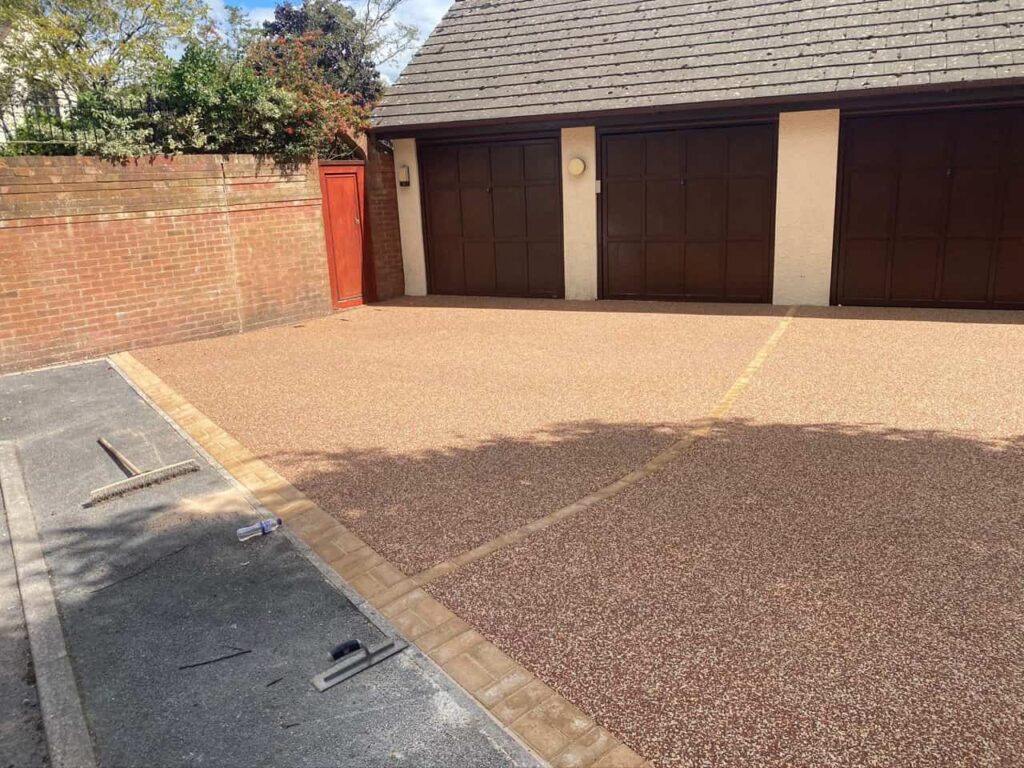
Why Does a Tarmac Driveway Need a Properly Prepared Base?
The visible tarmac is only one part of a driveway. Beneath it sits a carefully constructed base that distributes vehicle loads, maintains the intended levels and supports the surface during everyday use.
If this foundation is weak, uneven or poorly compacted, even well-laid tarmac can begin to sink, crack or distort. For homeowners in Letchworth Garden City, Hertfordshire, proper ground preparation is therefore essential to creating a stable and dependable driveway.
How the Base Supports a Tarmac Driveway
A tarmac surface is designed to provide a smooth, durable wearing layer. It does not have enough structural strength to compensate for unstable ground beneath it. The preparation must be appropriate for the soil conditions, intended traffic and shape of the driveway.
Excavation Removes Unsuitable Material
Driveway construction usually begins by excavating to a suitable depth. This removes topsoil, vegetation, loose material and any existing surface that cannot provide dependable support.
If unsuitable material is left in place, it can compress or move after the driveway is completed. This may cause depressions, uneven areas and cracks to form above it.
The required excavation depth depends on the ground conditions and anticipated use. This is why the site should be assessed rather than prepared to an arbitrary depth.
The Sub-Base Distributes Vehicle Loads
The sub-base spreads the weight of vehicles across a wider area. Without this layer, concentrated wheel loads could press directly into the soil and cause movement.
A correctly selected and installed aggregate forms a stable platform beneath the tarmac. It must be laid to an appropriate depth and distributed evenly across the excavated area.
Driveway entrances, turning points and regular parking positions often experience the greatest pressure. These areas require particularly careful preparation to prevent localised sinking.
Compaction Prevents Future Settlement
Placing aggregate into the excavation is not enough. It must be compacted thoroughly so that the particles interlock and form a dense, stable layer.
If the sub-base is loose, traffic can continue compressing it after installation. The tarmac may then settle unevenly, creating dips, wheel tracks or cracks.
Professional compaction is completed systematically across the entire area, including edges and restricted sections. Where necessary, the material may be installed and compacted in controlled layers rather than as one deep loose fill.
The Base Establishes the Correct Levels
The finished shape of a driveway is largely determined before the tarmac is laid. The base must establish consistent levels and suitable falls so that the surface has an even profile.
An inaccurate base can leave the tarmac too thin in some areas and unnecessarily deep in others. It can also create low points where rainwater collects.
Correct level setting is especially important around:
- Garage entrances
- Door thresholds
- Paths and patios
- Drainage channels
- Gates and boundary features
- Connections with existing surfaces
Planning these details at the preparation stage produces a neater and more practical finish.
Effective Drainage Begins Below the Surface
Although surface falls guide rainwater, the construction beneath the tarmac also influences drainage performance. Soft or waterlogged ground can lose stability and allow the driveway to move.
Site preparation may need to address poor ground conditions, existing drainage routes and areas where water naturally collects. The sub-base must remain stable while the completed surface directs rainwater towards the intended drainage points.
Simply laying new tarmac over an area with persistent pooling will not necessarily resolve the cause. The levels and supporting construction should be corrected first.
Edge Restraints Keep the Surface Contained
The edges of a driveway are vulnerable because they lack support on one side. Repeated wheel movement near an unsupported edge can cause the tarmac and base to spread or crumble.
Suitable edge restraints help contain the construction and preserve its shape. They also provide a defined boundary against lawns, planting areas, paving or loose materials.
Edging should be installed securely and incorporated into the overall level design before the main surface is completed.
A Stable Base Helps Prevent Cracks and Depressions
Tarmac has a degree of flexibility, but it cannot bridge significant movement beneath it. If the ground settles or the sub-base shifts, stress will transfer to the surface.
Typical signs of inadequate preparation can include:
- Wheel-track depressions
- Localised sinking
- Cracks that follow areas of movement
- Uneven transitions
- Water collecting in low spots
- Crumbling or spreading edges
- Patches that repeatedly fail
Repairing only the visible tarmac may not provide a lasting solution if instability remains underneath.
Existing Driveways Need Careful Assessment
Not every old driveway base must be removed. If the existing foundation is stable, well-compacted and suitable for the proposed surface, parts of it may remain usable.
However, an existing base should not be assumed to be sound simply because it is already present. Cracking, sinking and poor drainage may indicate deeper problems.
A professional assessment can determine whether the base is suitable for resurfacing, requires local correction or should be reconstructed more extensively.
Preparation Supports an Even Tarmac Finish
The quality of the base affects how consistently the tarmac can be laid and compacted. A smooth, correctly shaped foundation allows the material to be installed at an appropriate and even thickness.
This contributes to:
- A more uniform surface
- Better compaction
- Cleaner transitions
- More effective water run-off
- Stronger edges
- Consistent performance across the driveway
Good preparation may not be visible after completion, but its effect becomes clear through the way the driveway performs.
Conclusion
A properly prepared base gives a tarmac driveway its stability, shape and ability to withstand regular vehicle use. Suitable excavation, strong sub-base material, thorough compaction, effective drainage and secure edge restraints all contribute to a longer-lasting surface.
LGC Driveways & Patios provides professional tarmac driveway installation in Letchworth Garden City, Hertfordshire. If you are planning a new driveway or assessing an existing surface, contact us to arrange a site assessment and discuss the preparation required.
Call us on:01462 419 193
Click here to find out more about LGC Driveways & Patios
Click here to complete our contact form and see how we can help with your driveway needs.